Suppose $f$ is continuous for $x\geq0$, $f'(x)$ exists for $x>0$, $f(0)=0$, and $f'$ is monotonically increasing. Then $g(x):=\cfrac{f(x)}{x}$ is monotonically increasing for $x>0$.
Proof.
Let $a<b$, then $g(b)-g(a)=g'(x)(b-a)$ for some $x\in(a,b)$ by the mean value theorem. $g'(x)=\cfrac{xf'(x)-f(x)}{x^2}$. By the mean value theorem (again), $f(x)=xf'(x')$ for some $x'\in(0,x)$. But $f'$ is monotonically increasing, so $f'(x)\geq f'(x'), x'f(x)-f(x)=xf(x)-xf'(x')=x\{f'(x)-f'(x')\}\geq0, $. So $\cfrac{g(b)}{b}-\cfrac{g(a)}{a}\geq0$, concluding that $g$ is monotonically increasing.
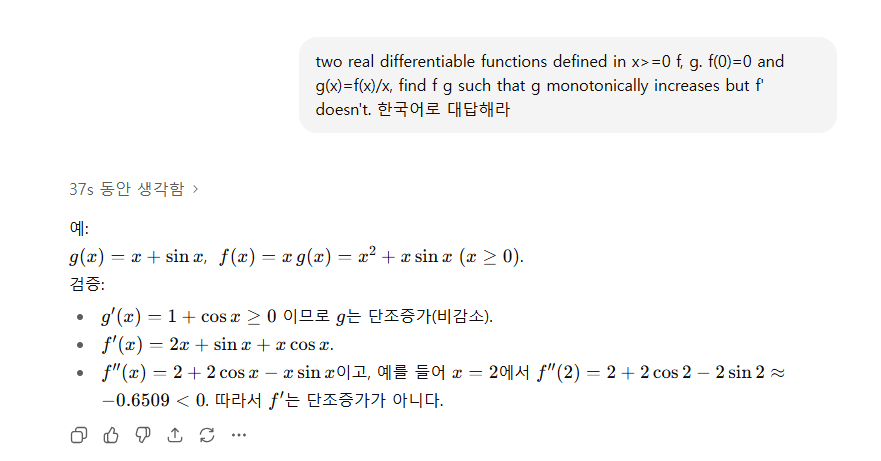
*Note that the inverse doesn't hold.
Example of $f$ such that the converse doesn't hold:
'math > analysis' 카테고리의 다른 글
| f is convex if and only if f' is monotonically increasing (0) | 2025.10.17 |
|---|